Answer Shelf

Tag: Science

  • Why Are Men Taller Than Women?

    Why Are Men Taller Than Women?


    It’s a noticeable trend across nearly every country in the world: on average, men are taller than women. But why does this height difference exist? The answer lies in a combination of biology, evolution, and even culture.

    Biological Differences

    The main reason men are generally taller than women is due to genetics and the influence of sex hormones during puberty. Testosterone, which is more prevalent in males, promotes bone growth, especially in the legs and torso. Estrogen, the dominant hormone in females, tends to cause the growth plates in bones to close earlier, which limits overall height.

    Both sexes experience a growth spurt during puberty, but boys typically hit this phase later and continue growing for a longer period than girls. As a result, even if a boy and a girl are the same height at age 11, the boy may end up taller by adulthood simply because he grows for a longer time.

    Evolutionary Theories

    From an evolutionary standpoint, greater male height may have been advantageous in the past. Taller males may have been more successful in competing for mates or providing protection, leading to a gradual selection for increased height in men. This is called sexual dimorphism, which refers to physical differences between males and females of a species due to evolutionary pressures.

    In humans, sexual dimorphism is moderate compared to some animals, but it still shows up in traits like height, muscle mass, and voice pitch.

    Cultural and Environmental Factors

    Nutrition and health during childhood can significantly influence how tall someone grows. In many parts of the world where resources are scarce, average heights for both sexes are lower. However, even in these regions, men still tend to be taller than women. This shows that while environment affects height, the male-female difference remains consistent.

    Cultural expectations may also subtly reinforce height differences. In some societies, tall stature in men is associated with strength and leadership, while tall women might not be perceived the same way. While this doesn’t cause the height difference, it might influence behaviors such as posture, diet, or activity level that play a small role in development.

    Exceptions and Overlaps

    It’s important to remember that averages don’t tell the whole story. Many women are taller than many men. Height is influenced by hundreds of genes and varies widely among individuals. While the global average height for adult men is roughly 5’7″ to 5’10” (170–178 cm), and for women around 5’2″ to 5’6″ (157–167 cm), these numbers can vary greatly by country and individual genetics.

    In summary:

    Men are generally taller than women due to biological and hormonal differences, especially during puberty. Evolutionary pressures and cultural influences have reinforced this trend, though there’s wide individual variation.

  • Why Do We Yawn?

    Why Do We Yawn?

    Yawning is something we all do, often without thinking about it. It sneaks up during long meetings, while watching TV, or just before bed. But despite how common it is, the science behind yawning is surprisingly complex, and still not fully understood.

    The Mechanics of a Yawn

    A typical yawn involves a deep inhalation through the mouth, stretching of the eardrums, and a noticeable widening of the jaw, followed by a slower exhalation. This simple act engages multiple systems in the body: respiratory, muscular, and neurological.

    Common Theories Behind Yawning

    1. Oxygen and Carbon Dioxide Regulation

    One of the oldest theories suggests yawning helps balance oxygen and carbon dioxide levels in the blood. When we’re tired or in a stuffy environment, we may breathe more shallowly, causing a buildup of CO₂. A yawn could act like a system reset, bringing in a big gulp of oxygen and expelling more carbon dioxide. However, studies have challenged this theory, showing people still yawn even when oxygen and CO₂ levels are controlled.

    2. Brain Cooling

    A more recent and widely accepted idea is the thermoregulatory theory – yawning helps cool down the brain. Just like a computer, your brain works best at an optimal temperature. When it overheats, cognitive performance can drop. Yawning increases blood flow and allows cool air to enter the sinuses, potentially lowering brain temperature and restoring alertness.

    3. State Transition Signal

    Yawning often appears at times of transition: waking up, falling asleep, or shifting focus. Some scientists believe yawning signals a change in mental state, helping the brain shift gears, from sleep to wakefulness, or from boredom to alertness.

    4. Contagious Yawning and Empathy

    Ever notice that seeing someone yawn makes you want to yawn too? That’s contagious yawning, and it’s especially common among close friends or family. Research links this phenomenon to social bonding and empathy. Brain imaging studies show that areas associated with social behavior and emotional connection light up when we witness someone yawning.

    Interestingly, contagious yawning is seen in other highly social animals too,like chimpanzees and dogs, suggesting it may serve a group-level function, such as synchronizing behavior.

    Why We Still Don’t Know Everything

    Despite centuries of observation, yawning resists a simple explanation. It’s likely that yawns serve multiple purposes: physiological, neurological, and social. Because yawning occurs in a range of situations, from fatigue to boredom, social mirroring to even anxiety, scientists think it might be a multifunctional behavior rather than having one specific role.

    Bonus Fact: Do All Animals Yawn?

    Yes, most vertebrates yawn. From reptiles to birds to mammals, yawning appears to be a deeply conserved behavior in the animal kingdom. However, the reasons they yawn might be different depending on the species. For example, in fish and amphibians, yawning may play a role in gill cleaning or respiration.

    Summary

    Yawning is still a bit of a mystery. It may help cool the brain, signal changes in alertness, or serve as a subtle form of social communication. What’s clear is that it’s a complex, multi-purpose behavior that plays a bigger role in our bodies, and our relationships, than we once thought.

  • Why Do We Itch, and Why Does It Feel Better to Scratch?

    Why Do We Itch, and Why Does It Feel Better to Scratch?

    Itching is one of those universal human experiences. Whether it’s from a mosquito bite, dry skin, or an allergic reaction, the sensation compels us to scratch. And that relief, even if brief, feels so good. But why do we itch in the first place? And what’s happening in our bodies that makes scratching so satisfying?

    What Causes Itching?

    Itching is a complex sensory experience triggered by many factors. At its core, it’s the body’s way of signaling that something may be wrong on the surface of the skin. Common causes include:

    • External irritants like insect bites, plant stings, or allergens
    • Skin conditions such as eczema, psoriasis, or hives
    • Internal issues, including liver or kidney problems, certain cancers, or nerve damage
    • Psychological triggers, such as anxiety or stress

    Specialized nerve endings in the skin, called pruriceptors, detect these irritants and send signals to the spinal cord and then to the brain. Unlike pain, which travels through different nerve pathways, itching is processed in a way that often leads to a reflexive response, scratching.

    Why Scratching Feels So Good

    When we scratch, we create a mild pain sensation that temporarily overrides the itch. This activates different nerve fibers and causes the brain to release chemicals like serotonin and dopamine, which can produce a sense of relief or even pleasure.

    The problem is that this relief is temporary. Scratching too much can damage the skin, worsen inflammation, and make the itch return stronger than before. This is known as the itch-scratch cycle.

    The Itch-Scratch Cycle

    1. An itch starts due to something like dry skin or an insect bite.
    2. Scratching provides relief but irritates the skin further.
    3. The body responds with more inflammation, releasing histamines and other chemicals.
    4. This leads to more itching, starting the cycle again.

    Repeated scratching can lead to chronic conditions where the skin becomes thickened and rough over time.

    What Helps Relieve Itching?

    Treating an itch depends on its cause. Here are a few commonly effective remedies:

    • Cool compresses can soothe the skin and reduce inflammation.
    • Moisturizers, especially those with colloidal oatmeal or ceramides, are useful for dry skin.
    • Antihistamines help with allergy-related itching.
    • Topical corticosteroids are effective for inflammatory skin conditions like eczema.
    • Avoiding irritants, such as strong soaps or scratchy fabrics, can prevent flare-ups.
    • Keeping fingernails short and using distractions can help reduce the damage caused by scratching.

    For more persistent or unexplained itching, doctors might prescribe medications that affect nerve signals, such as gabapentin or SSRIs.

    When to See a Doctor

    Itching is usually harmless, but in some cases, it can signal something more serious. You should talk to a healthcare provider if:

    • The itching lasts more than two weeks
    • It interferes with sleep or daily activities
    • There’s no clear cause
    • It is accompanied by other symptoms like weight loss or fatigue

    Final Thoughts

    Itching is more than just a skin-deep annoyance. It’s part of the body’s defense system, alerting you to potential irritants or health issues. While scratching may feel good in the moment, it’s not always the solution. Understanding the source of the itch and treating it properly is key to keeping your skin healthy and your hands away.

  • How Do Clouds Form?

    How Do Clouds Form?

    Clouds are one of the most familiar sights in the sky, yet their formation is a fascinating example of nature’s complexity. Understanding how clouds form helps us appreciate weather patterns, the water cycle, and even climate systems.

    The Basics of Cloud Formation

    At the heart of cloud formation lies a simple ingredient: water vapor. The process starts when the sun heats the Earth’s surface, causing water from oceans, lakes, rivers, and even plants (through transpiration) to evaporate into the atmosphere.

    As this moist air rises, it expands and cools because air pressure decreases with altitude. Cooler air can’t hold as much water vapor as warm air, so the excess vapor condenses into tiny water droplets or ice crystals. These droplets gather around microscopic particles like dust, salt, or smoke, called condensation nuclei, which provide surfaces for the moisture to cling to.

    When enough of these droplets accumulate, a cloud becomes visible.

    Types of Clouds and Their Formation

    Different cloud types form based on altitude, temperature, and atmospheric conditions:

    • Cumulus clouds: Fluffy and white, these often form on sunny days as warm air rises quickly.
    • Stratus clouds: These look like a blanket covering the sky and form when air rises slowly over a large area.
    • Cirrus clouds: High-altitude and wispy, these are made mostly of ice crystals.
    • Nimbus clouds: These are rain-bearing clouds that form when moisture-laden air cools rapidly.

    Each type tells us something about current or impending weather.

    Why Do Some Clouds Produce Rain?

    For a cloud to produce precipitation, the water droplets or ice crystals inside must grow large enough to overcome air resistance and fall to the ground. This happens when droplets collide and combine into larger drops in a process called coalescence. If the air is cold enough, the water may fall as snow or hail instead.

    Cloud Formation in the Water Cycle

    Clouds play a crucial role in Earth’s water cycle. They store and move moisture around the planet, eventually releasing it as precipitation that replenishes freshwater sources. After precipitation, water returns to the surface, and the cycle begins again.

    Final Thoughts

    Clouds are much more than pretty patterns in the sky. They are dynamic, ever-changing, and deeply tied to the planet’s climate and weather systems. The next time you look up, you’ll know that every cloud is a delicate balance of temperature, pressure, and water vapor at work.

  • How Do Noise-Cancelling Headphones Block Sound?

    How Do Noise-Cancelling Headphones Block Sound?

    Noise-cancelling headphones have become essential for travelers, commuters, and anyone seeking peace in noisy environments. But how exactly do these sleek gadgets hush the chaos around us? The answer lies in a clever blend of sound physics and smart electronics.

    Understanding Sound and Noise

    Sound travels in waves – vibrations that move through the air and reach our ears. Unwanted or disruptive sounds are considered “noise.” To cancel out noise, headphones must first detect it and then generate sound waves that interfere with it.

    Passive vs. Active Noise Cancellation

    There are two main ways headphones block out noise:

    1. Passive Noise Cancellation (PNC):

    This is the physical method of blocking sound. Over-ear headphones with thick padding or in-ear earbuds with tight seals create a barrier that reduces external noise, particularly high-frequency sounds like chatter or clinking dishes.

    2. Active Noise Cancellation (ANC):

    This is the real magic. ANC uses built-in microphones to pick up ambient sounds like engine hum or air conditioning. The headphone’s processor then generates a new sound wave that is the exact opposite (or antiphase) of the incoming noise. When these two waves combine, they cancel each other out through a phenomenon called destructive interference.

    This process works best for consistent, low-frequency sounds. It’s why ANC headphones are great on airplanes but might not fully cancel unpredictable noises like shouting or sudden bangs.

    The Role of Technology

    Modern noise-cancelling headphones include advanced digital signal processors (DSPs) that react in real time. Some models even use adaptive algorithms that adjust based on your environment, like a quiet room versus a busy train station. Newer versions also allow “transparency mode,” which lets certain sounds (like voices or announcements) through, giving you more control over what you hear.

    Limitations of Noise Cancelling

    While effective, ANC isn’t perfect. It works best for steady noise and may slightly affect sound quality in some cases. Also, ANC requires power, usually a battery, so if it runs out, you’re left with just passive noise reduction.

    Why It Matters

    By reducing background noise, noise-cancelling headphones allow you to enjoy music at lower volumes, reduce listening fatigue, and stay focused. For frequent travelers or people working in noisy environments, they’re more than just a luxury, they’re a practical tool.

    Summary

    Noise-cancelling headphones use a combination of physical barriers and sound wave manipulation to block unwanted noise. With microphones, processors, and smart algorithms, they detect ambient sounds and produce opposing waves to cancel them out. This technology offers a more peaceful listening experience, especially in loud or repetitive environments.

  • What Are Chromosomes?

    What Are Chromosomes?

    Chromosomes are tiny structures inside our cells that carry the instructions for life. They’re made of DNA and proteins, and they hold the genetic information that tells our bodies how to grow, develop, and function. Think of them as tightly packed instruction manuals, passed down from your parents, that determine everything from your eye color to your risk for certain diseases.

    Where Are Chromosomes Found?

    Chromosomes live in the nucleus of most of your body’s cells. The nucleus is like the cell’s control center. Inside, chromosomes are coiled up neatly so that the long strands of DNA they’re made of can fit into a tiny space.

    How Many Chromosomes Do Humans Have?

    Humans have 46 chromosomes in total, arranged in 23 pairs. You inherit one set of 23 from your mother and another set from your father. Of these:

    • 22 pairs are called autosomes, which contain the majority of your genes.
    • The 23rd pair are the sex chromosomes, which determine your biological sex:
      • XX = typically female
      • XY = typically male

    What Are Chromosomes Made Of?

    Each chromosome is made up of:

    • DNA (deoxyribonucleic acid): The molecule that contains the genetic instructions.
    • Proteins (mainly histones): These help package the DNA into a compact, organized shape.

    When DNA is tightly wound around these proteins, it forms a structure that can be easily moved and sorted during cell division.

    What Do Chromosomes Do?

    Chromosomes serve one major purpose: they carry genes. Genes are specific segments of DNA that provide the instructions for making proteins, which do most of the work in your body. These instructions control traits like your height, skin tone, metabolism, and much more.

    Without chromosomes, your cells wouldn’t know how to build and maintain your body.

    What Happens When Something Goes Wrong?

    Sometimes, people are born with too many or too few chromosomes, or with structural changes to their chromosomes. These differences can lead to health conditions. A few examples include:

    • Down syndrome: Caused by an extra copy of chromosome 21 (trisomy 21).
    • Turner syndrome: Occurs when a female is missing part or all of one X chromosome.
    • Klinefelter syndrome: Happens when a male has an extra X chromosome (XXY).

    These conditions can affect growth, development, and fertility, but they vary widely in their impact.

    Why Are Chromosomes Important in Medicine?

    Understanding chromosomes helps doctors and scientists:

    • Diagnose genetic disorders
    • Study inherited traits
    • Develop treatments for certain diseases
    • Understand cancer, which often involves chromosome damage or mutations

    In recent years, advances in genetic testing and genome mapping have made it easier to look at chromosomes and identify potential health risks before symptoms appear.

    Chromosomes may be microscopic, but they play a huge role in shaping who we are. From carrying the genetic blueprint that builds our bodies to influencing our health and development, these tightly packed strands of DNA are essential to life. As science advances, our understanding of chromosomes continues to grow, opening new doors in medicine, genetics, and the study of human biology.

  • Why Does It Rain?

    Why Does It Rain?

    Rain is one of nature’s most essential processes, but have you ever wondered why it actually happens? From watering crops to filling reservoirs, rainfall plays a vital role in the Earth’s ecosystem. The science behind rain is surprisingly elegant and involves a delicate balance of temperature, pressure, and moisture in the atmosphere.

    The Water Cycle: Nature’s Circulating System

    To understand why it rains, we first need to look at the water cycle, also known as the hydrologic cycle. This natural process continuously moves water through different stages:

    1. Evaporation – The sun heats up water in oceans, lakes, rivers, and even puddles, turning it into water vapor.
    2. Condensation – As the vapor rises into the atmosphere, it cools and turns into tiny water droplets, forming clouds.
    3. Precipitation – When these water droplets gather and grow heavy enough, they fall to Earth as rain, snow, sleet, or hail.
    4. Collection – The fallen water collects in bodies like rivers and oceans, and the cycle begins again.

    What Triggers Rainfall?

    While the water cycle sets the stage, certain atmospheric conditions actually trigger rainfall:

    • Humidity: The more water vapor in the air, the more likely it is to condense and form rain-producing clouds.
    • Cooling of Air: When warm, moist air rises and cools (often due to elevation or weather fronts), it condenses rapidly.
    • Cloud Saturation: When clouds become saturated, meaning they can’t hold any more moisture, rain begins to fall.
    • Particles in the Air: Dust, pollen, and other particles act as nuclei for water vapor to cling to during condensation.

    Types of Rain

    Not all rain is the same. Here are the three primary types:

    • Convectional Rainfall: Caused by intense heating of the Earth’s surface, common in tropical regions.
    • Orographic Rainfall: Occurs when moist air is forced to rise over mountains.
    • Frontal Rainfall: Happens when a warm air mass meets a cold one, causing the warm air to rise and cool.

    Why Rain Matters

    Rain is crucial for:

    • Irrigating Crops: Without rain, many regions would face agricultural challenges.
    • Replenishing Groundwater: Rain feeds aquifers and lakes that supply drinking water.
    • Maintaining Ecosystems: Forests, wetlands, and rivers all rely on regular rainfall to thrive.

    Can Humans Influence Rain?

    While weather modification techniques like cloud seeding have been developed to encourage rainfall, their effectiveness is still debated. However, climate change is having a noticeable impact on global rainfall patterns, making dry areas drier and wet areas wetter.

    Conclusion

    Rain is more than just water falling from the sky, it’s the result of a finely tuned natural system that sustains life on Earth. Next time you see storm clouds gathering, you’ll know the fascinating science behind every drop.

  • Why Do Cats Make Biscuits?

    Why Do Cats Make Biscuits?

    If you’ve ever watched a cat rhythmically kneading a soft blanket, pillow, or even your lap with its front paws, you’ve witnessed a behavior affectionately known as “making biscuits.” This charming term describes the repetitive pressing motion that resembles a baker kneading dough. But why do cats do this? As adorable as it is, kneading is more than just cute, it has deep-rooted biological and emotional significance.

    1. Kitten Instincts and Nursing Behavior

    Kneading begins in kittenhood. Newborn kittens instinctively knead their mother’s belly to stimulate milk flow during nursing. This rhythmic motion is comforting and essential for their survival in early life. As cats grow older, they often carry this behavior into adulthood as a leftover instinct, especially in moments of comfort or relaxation.

    2. Comfort and Contentment

    Adult cats frequently knead when they’re feeling safe, happy, and content. If your cat makes biscuits on your lap or near you, it’s a strong sign of trust and affection. This behavior often accompanies purring, closed eyes, and a relaxed posture – all indicators that your cat is in a state of bliss.

    3. Territory Marking

    Cats have scent glands in their paw pads. When they knead, they’re not just showing contentment; they may also be marking their territory. By leaving their scent on a surface, they are claiming it as their own — a behavior deeply rooted in feline communication.

    4. Preparing a Nest

    In the wild, cats may knead soft grasses or leaves to create a comfortable, safe place to rest or give birth. Domestic cats may replicate this nesting behavior on blankets, furniture, or your lap – essentially making the area feel more like home.

    5. Stretching Muscles

    Kneading also helps stretch the muscles in a cat’s paws and shoulders. It’s a simple way to stay limber, especially before or after a nap. This might be one of the reasons you see your cat kneading before settling down for a snooze.

    6. Emotional Connection

    Some experts believe that kneading is a way for cats to bond with their human companions. By making biscuits on your lap, your cat might be expressing love and attachment, similar to how they connected with their mother as kittens.

    Should You Worry About Kneading?

    Generally, kneading is a harmless and healthy behavior. However, some cats may use their claws during kneading, which can be uncomfortable or damaging to furniture. You can place a blanket on your lap to protect yourself, or gently redirect your cat to a more appropriate spot. Never punish a cat for kneading, it’s a deeply ingrained and instinctual action.

    Final Thoughts

    Whether it’s a throwback to kittenhood or a sign of affection, kneading is one of the many ways cats communicate and care for their environment, and for you. So the next time your feline friend starts making biscuits, take it as a compliment. You’ve earned a cozy spot in their heart.

  • What Is Static Electricity, and Why Do We Get Shocked?

    What Is Static Electricity, and Why Do We Get Shocked?

    Ever touched a metal doorknob and felt a sudden zap? Or noticed your clothes clinging together after being in the dryer? That’s static electricity at work. But what exactly causes this invisible force, and why does it sometimes give us a jolt?

    What Is Static Electricity?

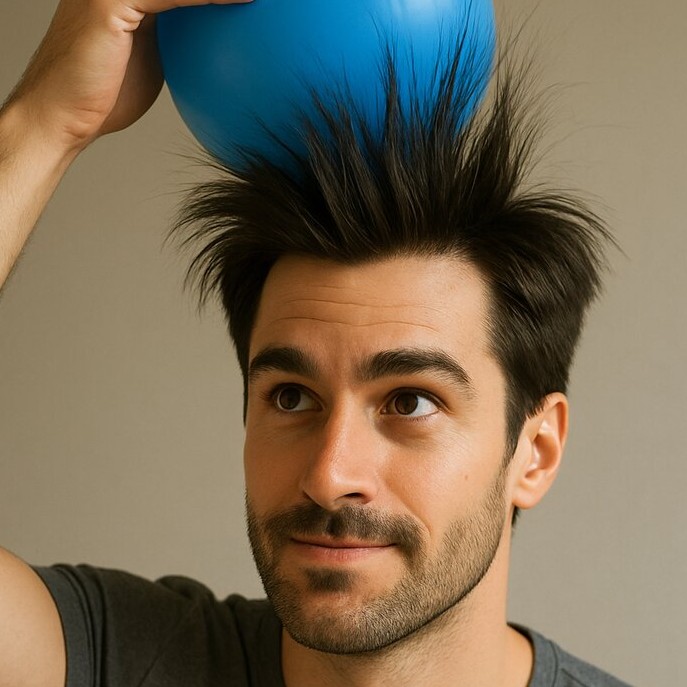
    Static electricity is the buildup of an electrical charge on the surface of an object. It happens when electrons (which are negatively charged) are transferred from one material to another through friction. One object ends up with more electrons and becomes negatively charged, while the other loses electrons and becomes positively charged.

    Unlike current electricity, which flows through wires to power your devices, static electricity stays still – hence the term static. It only discharges when it finds a way to equalize the imbalance.

    How Does It Build Up?

    Static electricity builds up most often through everyday activities like:

    • Walking on a carpet in socks
    • Rubbing a balloon on your hair
    • Taking clothes out of a dryer

    In these cases, your body or another object collects excess electrons. The buildup continues until there’s an opportunity for the electrons to jump to something with a different charge, often resulting in a small shock.

    Why Do We Get Shocked?

    The little shock you feel when touching a doorknob or another person is the sudden discharge of built-up static electricity. When your charged body touches a conductive material (like metal), electrons leap across the gap to balance out the charges. That quick movement of electrons is the spark you feel, essentially a mini lightning bolt.

    Some conditions make these shocks more likely:

    • Dry air: Moisture helps disperse charges, so static builds up more easily in low-humidity environments, like heated indoor spaces in winter.
    • Synthetic materials: Fabrics like polyester and nylon are more prone to holding static charges than natural fibers.
    • Insulated shoes: Rubber soles prevent charge from grounding, increasing buildup.

    Is It Dangerous?

    For everyday shocks, static electricity is more annoying than harmful. However, in industrial settings or around flammable substances, static discharges can be hazardous and even cause explosions, which is why proper grounding procedures are essential in such environments.

    Can You Prevent It?

    While you can’t eliminate static electricity completely, there are ways to reduce its effects:

    • Use a humidifier indoors during dry months
    • Wear natural fiber clothing like cotton
    • Touch grounded metal objects before handling electronics
    • Use leather-soled shoes instead of rubber ones

    The Bottom Line

    Static electricity is a natural phenomenon that occurs when electrons accumulate due to friction. Though usually harmless, it can be a surprise when you get zapped by a doorknob or your clothes stick together. Understanding the science behind it can help you manage it, and maybe even impress your friends with your new knowledge.

  • Why Does Plastic Turn Yellow Over Time?

    Why Does Plastic Turn Yellow Over Time?

    If you’ve ever noticed a once-clear plastic item turn an unsightly shade of yellow, you’re not alone. From old electronics and kitchen containers to vintage toys and appliances, plastic discoloration is a common issue. But what causes this yellowing over time?

    The Science Behind the Yellowing

    The yellowing of plastic is primarily due to oxidation and UV light exposure. Many plastics, especially older ones like ABS (acrylonitrile butadiene styrene) and polycarbonate, contain chemical additives that break down when exposed to oxygen and sunlight.

    When ultraviolet (UV) rays hit the plastic surface, they trigger a chemical reaction that alters the molecular structure. This process is called photo-oxidation. Over time, the plastic’s polymer chains degrade and react with oxygen in the air, producing yellow-colored byproducts that become trapped in the material.

    Contributing Factors

    1. UV Exposure: Sunlight is the most powerful contributor. Even indirect exposure through windows can affect indoor plastics.
    2. Heat: Elevated temperatures can accelerate the chemical reactions that lead to yellowing.
    3. Ozone and Pollutants: Air pollutants and ozone can react with plastic surfaces, hastening the discoloration.
    4. Plastic Composition: Some plastics are more prone to yellowing depending on their additives and stabilizers. Cheaper or older formulations are often less resistant.

    Can You Reverse the Yellowing?

    In some cases, yes—at least temporarily. DIY methods like using hydrogen peroxide baths and UV light treatments (often called “retrobright”) can reduce yellowing on certain plastics, especially for collectibles and electronics. However, these methods can weaken the plastic over time or cause uneven results. The yellowing often returns with re-exposure to the same conditions.

    Preventing Yellowing

    • Limit sun exposure: Store plastic items away from windows or in opaque containers.
    • Use UV-protective coatings: For plastics exposed to light, protective sprays or films can block UV rays.
    • Control temperature and humidity: Avoid storing plastic items in hot or damp areas like attics or garages.

    Final Thoughts

    Plastic yellowing is a natural consequence of chemical aging, especially when UV light and air exposure come into play. While you can slow down the process or temporarily reverse it, the best solution is prevention. If you’re keeping vintage plastic items or electronics, storing them properly can make all the difference in preserving their original look.